
It’s August 2019 and Khwab Nazir is waiting to board the plane at Terminal 3 of New Delhi International Airport. Sent to represent India at an international jiu-jitsu tournament, Khwab nervously looks towards her unknown future. She also reflects on her complicated past — growing up against the insurmountable difficulties of life in Kashmir.
Between happiness and emptiness, desire and grief, penance and peace, Khwab has endured it all. She has a dream that life will be a paradise, one day. Breathing against the backdrop of conflict, Terminal 3, is the story of the everyday people striving to live their dreams in the Valley.
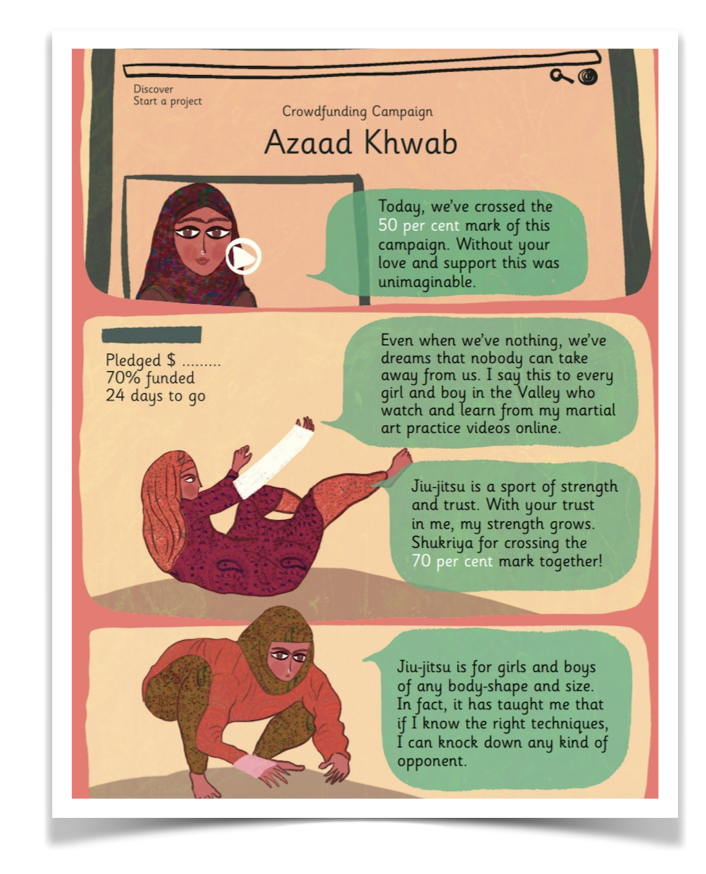
I’m not a graphic novel fan, truth be said. But Dasgupta’s artwork drew me in, and I kept turning the pages from start to finish, mesmerised by her line work and her choice of colours. The story unfolds through the images and text. The prose is lyrical, poetic, and the dialogue brought out each character’s voice distinctly, although I found some of the prose to be too expository, telling more than showing me what’s going on. But the artwork showed me what a Kashmiri interior — the inside of a home — looks like, for example. Dasgupta’s eye for detail is superlative. Her use of colours distinctive. It is evident that behind those images and textures, she had done a lot of research and image sourcing.
What I did like a lot of is that Terminal 3 is a layered story of the conflict in Kashmir seen through the eyes of two best friends, Khwab and Noor, who are torn apart by the trouble that surrounds them. Khwab’s story is fused with Noor’s in the kind of way that lives are joined in this world.
This is a story about international borders invented by men to keep people apart. It is a story about sports — jiu-jitsu — and an Indian sportswoman who has a fighting spirit so strong that ‘failure is never the last answer.’ It is a story about friendship that knows no borders and boundaries. I love that it is story of female bonds that nothing can asunder.

It is good to know that jiu-jitsu, meaning ‘gentle art’ in Japanese, is a self-defence martial arts that is highly regarded around the world. This combat sport does not allow for sparring partners to strike back. Jiu-jitsu is based on ground fighting, grappling and submissive holds, and most of all strategy. Dasgupta chose this gentle and artful sport as a symbol for and metaphor of quiet strength within oneself and that winning lies not in being brutish and forceful but in having quiet determination and resilience.
Here are some of my favourite lines:
“Only fools think that those lines can define our identities.”
“My soul will resurrect from the ashes of my bones.”
“Who says that your dreams are not mine? You once told someone that dreams don’t have borders.”
Terminal 3 is page-turning but it wasn’t an easy story to read as there were so many gaps that needed filling for me, a stranger to the conflict in Kashmir. Stories, as we know, help readers to be more empathetic and compassionate, and they also ignite a curiosity in us. Dasgupta is a storyteller and a change-maker, and Terminal 3 is a story that helped changed my apathy to the situation in the Valley, and made me more curious to find out more about the history of the Kashmiri people.

0 Comments